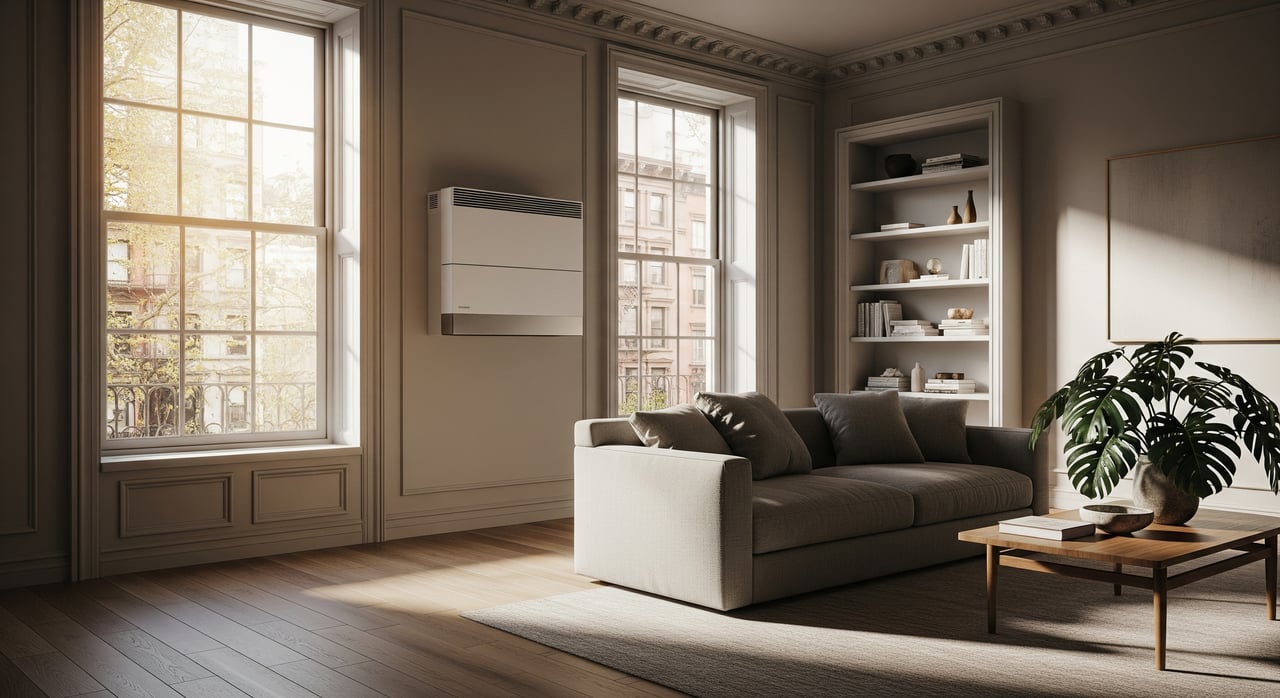
Sweating through summer and shivering in winter is a common West Village story, especially in charming prewar buildings that were never designed for central air. You want better comfort without upsetting your board or altering a landmarked facade. This guide breaks down heat pump options that work in West Village apartments, how to minimize visual impact, and what to expect with boards, permits, and timelines. Let’s dive in.
Why heat pumps fit West Village
Many West Village homes are prewar co-ops, condos, brownstones, and low- to mid-rise buildings that rely on central steam or hot-water heat. Most apartments do not have ductwork, which makes traditional forced-air systems impractical. Heat pumps deliver heating and cooling through compact indoor units, so they fit these buildings well.
New York City also encourages electrification, and larger buildings face emissions limits under Local Law 97. While that is a building-level issue, it is increasing interest in heat pump adoption across the neighborhood. For individual apartments, modern cold-climate models can provide reliable heat in NYC winters and efficient, quiet cooling in summer.
Option 1: Ductless mini-splits
How they work
A ductless mini-split pairs indoor heads with a single outdoor condenser. You can serve one room or multiple rooms, and you do not need existing ducts. Indoor units can be wall-mounted, floor consoles, or ceiling cassettes.
Where they fit
Mini-splits are ideal when you want zoned comfort and minimal interior disruption. They are a strong match for prewar apartments with radiator heat because they add high-efficiency cooling and supplemental heat without major ductwork.
Key advantages
- High efficiency for heating and cooling.
- Zoned comfort room by room.
- Small wall penetrations and compact indoor units.
- Cold-climate models maintain capacity at low outdoor temperatures.
What to watch on facades
Every mini-split needs an outdoor condenser and refrigerant lines. In the West Village, much of the area falls within Landmarks Preservation Commission districts. Visible condensers on street-facing facades, exposed line sets, and new wall sleeves can trigger LPC review and often board concerns. You will likely need board approval and, if equipment is publicly visible, LPC sign-off.
Design-forward placement ideas
- Place condensers on setback roofs, rear yards, light wells, or interior courtyards when possible.
- Route refrigerant lines internally to avoid facade runs and visual clutter.
- Consolidate condensers on the roof to serve multiple rooms while keeping the street face clean.
- Use paintable screens or enclosures, set back from primary facades, and specify low-profile equipment color-matched to masonry.
Costs and timeline
Pricing varies by building constraints and equipment quality. A single-head mini-split often falls in the low-to-mid thousands of dollars per zone. Multi-zone systems cost more but can serve several rooms from one outdoor unit. Rooftop consolidation, electrical upgrades, facade concealment, and restoration can add material cost and time. A single room can be completed in a day or two, while larger or roof-routed systems take longer.
Option 2: PTHP replacements
When they make sense
Packaged Terminal Heat Pumps are through-the-wall units that slide into an existing wall sleeve. If your apartment already has a sleeve from a PTAC, a PTHP can be a familiar, lower-impact swap that adds both heating and cooling.
Pros and limits
- Replacement in an existing sleeve is often straightforward and lower cost than a full mini-split install.
- Visual impact is confined to the current opening.
- Less efficient and usually noisier than modern mini-splits.
- Limited zoning flexibility compared with multi-head systems.
Sleeve and LPC considerations
Many West Village apartments do not have sleeves. Cutting a new sleeve is a significant facade alteration that typically triggers LPC review and board scrutiny, and it may be structurally or aesthetically infeasible. If a sleeve exists, a PTHP can be a pragmatic solution.
Other pathways to consider
Compact ducted mini-splits
A small, ducted air handler can serve multiple rooms with short duct runs and fewer visible indoor units. You need ceiling or closet space for the plenum and some interior drywall work, but you gain a clean look with fewer wall heads.
Portable and window heat pumps
Portable or window-mount heat pumps have limited performance and can be visually prominent. In landmarked settings and many co-ops or condos, they are often restricted.
Whole-building heat pumps
Switching an entire building to central air-source or ground-source heat pumps is possible but complex. It requires major mechanical, electrical, and structural work and is usually a board or building owner decision. For large buildings subject to Local Law 97, this can be a strategic long-term path.
Permits, boards, landmarks
Most co-op and condo boards require written approval for HVAC work. Expect to submit plans, contractor licenses and insurance, and equipment specifications. Boards may set rules for outdoor equipment placement, noise levels, and restoration of common elements.
Exterior mechanical work that is visible from public ways and some rooftop installations may require Landmarks Preservation Commission approval. Early consultation is smart, especially for condensers, screening, new sleeves, or roof penetrations. Interior-only work that does not affect the exterior typically does not require LPC review.
HVAC installations can require Department of Buildings permits and licensed trade filings. Electrical work, including panel or service upgrades, must be handled by a licensed electrician with proper permits. Always confirm the exact filing needs with a licensed professional before work begins.
Technicians handling refrigerants must be EPA-certified, and state rules apply to contractor licensing. Ask for proof of certifications and ensure your team has experience in multi-family and landmark projects.
Performance in NYC winters
Cold-climate air-source heat pumps maintain useful capacity at low temperatures and are effective in New York City. Efficiency declines in very low temperatures, so proper sizing and envelope conditions matter. In older or drafty units, you may need supplemental heat during rare extreme cold snaps. Even if your building has central steam, a mini-split can provide primary cooling and shoulder-season heat while the radiators handle deep winter.
Electrical and noise planning
Older units may have limited electrical capacity. Your contractor should perform a load review to determine if you need new circuits, a panel upgrade, or building-level coordination for service increases. Whole-building electrification requires utility coordination and an electrical study.
Noise and vibration are common concerns in multi-family buildings. Indoor mini-split heads are typically quiet, while outdoor condenser noise depends on placement and model. Boards and LPCs often require decibel limits or testing. Anti-vibration pads and rubber mounts help reduce transmission to neighbors and structure.
Incentives and rebates overview
Federal, state, and utility incentives support heat pump adoption. The Inflation Reduction Act created tax credits for qualifying heat pumps, while NYSERDA and Con Edison offer programs that can offset costs. Program rules and amounts change over time, and income or building type can affect eligibility. Check the current NYSERDA, Con Edison, and IRS resources and consult a tax professional before you finalize budgets.
Step-by-step plan
Identify your building context. Note if you have steam or hot water heat, existing wall sleeves, rooftop access, and any board rules related to exterior equipment.
Check governance early. Review your co-op or condo documents and ask management for written guidance on what is allowed and what approvals are required.
Book a site visit. Engage an HVAC contractor experienced with landmark and multi-family work to assess load, electrical capacity, routing paths, and feasible outdoor locations.
Coordinate with preservation. If any equipment may be visible, consult a preservation architect or the Landmarks Preservation Commission early to understand what filings are needed.
Get multiple quotes. Ask about refrigerant type, outdoor unit noise ratings, screening options, DOB and LPC filings, electrical upgrades, and restoration scope for any facade or roof work.
Choose a low-visibility solution. Favor internal line routing, roof or rear placements, and consolidated condensers. Consider ceiling cassettes where wall heads would disrupt the look of a room.
Plan timing and access. Expect a day or two for a single zone and more for multi-zone or roof-routed systems. Coordinate elevator reservations, protection of common areas, and quiet hours.
Questions to ask
- Where will the outdoor condenser sit, and will lines be routed internally?
- What are the outdoor unit’s decibel levels at the proposed location?
- What refrigerant is used and are technicians certified to handle it?
- Which DOB and LPC filings are required, and who manages them?
- Will I need a panel or service upgrade, and who coordinates with the building or utility?
- What warranties cover the installation and any building-interface work like facade patching or roof penetrations?
What this means for resale
Adding efficient, quiet cooling and supplemental heat often improves daily comfort and perceived value. Buyers appreciate modern systems, especially ones that respect landmark character and minimize facade impact. Clean equipment placement, discrete line routing, and documented approvals can strengthen a listing’s story.
Ready to explore?
If you are weighing comfort upgrades as part of a purchase or prepping a West Village home for market, let’s align your plan with building rules and realistic timelines. With design-minded guidance and a clear process, you can improve comfort while protecting the character that makes the neighborhood special. Let’s Connect.
FAQs
Do heat pumps work in older West Village apartments?
- Yes. Cold-climate models perform well in NYC, but correct sizing and insulation matter, and very drafty units may need supplemental heat during extreme cold.
Can I place a condenser on a street-facing facade?
- This is often difficult. LPC prefers concealed placements like setback roofs, rear yards, or light wells, and visible facade penetrations can be denied or require mitigation.
Do I need my co-op or condo board’s approval for a heat pump?
- Almost always. Boards typically require plans, contractor documentation, and placement details, and they may set noise limits and restoration requirements.
Are there incentives to lower the cost of a heat pump?
- Yes. Federal, state, and utility programs exist, but availability and amounts change. Check current NYSERDA, Con Edison, and IRS guidance and confirm eligibility.
Will I need an electrical upgrade for a mini-split?
- Possibly. Older apartments may need new circuits or panel upgrades, and whole-building work can require utility coordination. A load review will clarify what is needed.
How long does installation take in an occupied apartment?
- A single-head mini-split is often one to two days. Multi-zone systems, rooftop routing, sleeves, and any facade restoration add time and coordination.
